Operation Torch
Diary of Anne FrankOperation Torch, the Allied landings in North Africa, appears in Anne Frank’s diary as a piece of war news that briefly changes the emotional weather of the Secret Annex. Reported on Peter’s sixteenth birthday, it prompts talk of an approaching end while Churchill’s more measured words preserve the distance between a hopeful turning point and actual liberation.
The News Reaches the Annex
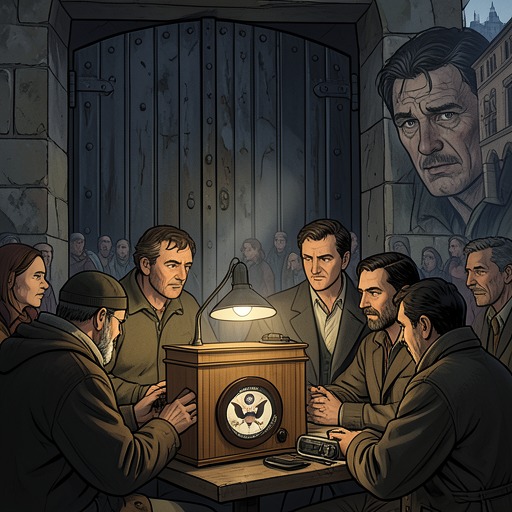
The report arrives amid the intimate details of Peter’s birthday. Anne is upstairs by eight, and she and Peter look over his presents: a Monopoly game, a razor, and a cigarette lighter. At one o’clock, Mr. van Daan brings the larger surprise: the English have landed in Tunis, Algiers, Casablanca, and Oran. The news carries the war’s distant movement into the confined rooms of the Annex, where events beyond the hiding place are followed for what they might mean to those trapped inside.
Hope and Historical Perspective
The landing report immediately acquires a larger meaning in the Annex. Everyone is saying, “This is the beginning of the end,” but the diary sets that shared excitement beside Winston Churchill’s warning: “This is not the end. It is not even the beginning of the end. But it is, perhaps, the end of the beginning.” Anne directly asks Kitty to notice the distinction. The contrast does not extinguish optimism; it gives hope a more cautious measure, separating a major Allied advance from the end of the danger facing those in hiding.
Significance Within the Diary
The significance of Operation Torch in the diary lies not in a detailed account of military events, but in the way distant news is filtered through the conditions of hiding. Anne’s account first establishes the restrictions imposed on Jews in the Netherlands: they had to wear the yellow star and faced sweeping prohibitions on movement and ordinary public life. Against this loss of freedom, news of Allied forces landing in North Africa could be heard as a possible sign that the war might turn. The landing therefore registers as both a historical development and a change in the Annex residents’ immediate expectations.
A Distant Turning Point Under Occupation
The cautious hope surrounding the landings gains force against the realities that the diary records elsewhere. After the German occupation, anti-Jewish decrees narrowed daily life through the yellow-star requirement and bans on ordinary transport, public entertainment, and evening movement. The Frank family’s plan to hide in Otto Frank’s office building was brought forward ten days when Margot received a call-up notice; later, even the concealed rooms were vulnerable to break-ins, and their residents responded to danger with stricter routines and new security measures. Operation Torch did not itself release them from those constraints, but it gave the news they followed from hiding a possible direction: the war might be moving toward an end, even when safety remained uncertain.